‘AUREUSON’, THE TREASURE OF THE CITIZEN, The Imminent future, a reflection on AI & Why I Oppose All Movements That Divide Us
Updated: Aug 2
O.K, let me be completely honest straight from the get go, I’m writing this because I’m afraid of these times we’re in. How easily we are deceived? And where will this end?
I need to clarify straight up that I am not aligned with any political party. I don't belong to a political tribe. I vote issue by issue, election by election, because no party represents the whole of what I believe. My loyalty is not to a party but to some basic ethics and principles that guide me.
These principles, include:
Love thy neighbour and do unto others as you would have others do unto you.
Individual responsibility matters. People should be encouraged to work hard, create, innovate and be rewarded for doing so.
Markets are extraordinarily powerful, but they are not moral actors. They require rules and accountability.
Tax is not theft; it is one of the prices we pay for living together. I don't resent paying tax when it genuinely provides opportunity, healthcare, education and a safety net for those who need it.
At the same time, taxation shouldn't become punitive to the point that it discourages effort, enterprise or aspiration.
Corporations should never enjoy the rights of individuals while escaping equivalent responsibilities. When governments become captured through lobbying, donations, preferential treatment or corporate welfare, democracy begins to erode.
Governments should be questioned. Corporations should be questioned. Ideologies should be questioned. Nobody should receive unquestioning loyalty.
Freedom matters, but so does responsibility. Rights and duties are two halves of the same coin.
Democracy works best when citizens can disagree without seeing one another as enemies.
I’ve written about it at more length and with more heart and clarity in the ‘About’ section on my website, specifically the writing titled ‘This I believe’.
I’m naturally suspicious of certainty and prefer to inhabit a space of curiosity. I love to learn new things and am always open in every argument to be corrected. I have no need to be right. I’d rather learn. I say all of this in advance, because this blog is dense and I imagine most people won’t get through it. It’s a lot of words and thoughts cascading on one another, but if you do get to the end, I think you will see there is an over-reaching point to it all.
It’s not for everyone, and there will no doubt be sections you will disagree with, but I hope overall you can push through that discomfort to get the whole picture that I am painting here. If you do, you’re definitely my kind of people.
These are things I’ve struggled with and wanted to say for some time, but have kept to myself in fear of upsetting others and alienating myself. But my shy voice has continued to whisper these thoughts to me and I feel I must honour their persistence. It seems almost like a calling to honour free speech itself, as though by hiding; by shrinking myself in hope of the comforts of conformity, that I am betraying in some way the very voice of my creative freedom. George Orwell once wrote, "the imagination, like certain wild animals, will not breed in captivity. The writer who denies truth will lose his literary capacity." This idea is at the very heart, of why I'm daring in this blog to expose myself, even if my position at times seems completely hypocritical, you can be sure it is born from a deep struggle, in my feeble capacity to strive for truthfulness. If you shrink away in fear of speaking truth to power as an artist or as a journalist, you risk losing your muse altogether. The muse is sensitive and will quickly leave if ignored. The artist who repeatedly shrinks from speaking honestly doesn’t merely lose their courage; they risk losing their muse. Inspiration is a shy companion. Ignore it often enough, and one day it simply stops knocking.
It's the idea that truthfulness is the condition under which creativity itself survives. And for those who think artists such as I should shut our mouths when it comes to politics; I just have one other powerful George Orwell quote to consider, “The opinion that art should have nothing to do with politics is itself a political attitude.” You see, for an artist it's an imperative, the muse doesn’t ask us to be popular. She asks us to be honest. Every time we silence ourselves out of fear, she quietly takes a step towards the door. On another note, I will add I’ve edited this document a number of times now since first writing it and I’m realising that like truth itself, it wants to remain fluid and constantly evolving. Whenever I have seen a 'like' on my initial Facebook post about this blog by somebody I think would vehemently disagree with some aspect of this blog, it forces it me to reconsider it from another angle, holding the complexity of two opposing points of view at once, is not sitting on the fence, it's just an openness, the kind of which this whole piece is arguing for. I guess within this is a longing for prudence, a careful self watch, a process of self correction and betterment. Three events are swimming around in my mind today; let me start firstly with the passing of one of my heroes, Glen Hansard, who had such a rare gift. His voice was so pure and powerful. He could rip your heart out of your chest with a song and hand it back to you as tears poured from your eyes. He had such power, such presence and such honesty. It was like watching a lightening storm and feeling the thunder crack; he really was a force of nature.He had a compassion, a wisdom, and a shared humanity that opened a door into the truth of what it is to be human in all it's fragility and beauty. I had only recently watched his live gig at Funkhaus with the full band, strings and all and had been touched to see the way the audience were moved, as I have been by his music. Each person in the audience had built a private home for Glen in their hearts. That deep connection can't be bought, it has to earned, one gig after another. One new fan by one, over many years, over many conversations, over many moments of being present and listening deeply to one another. Such trust is deeply earned. Absolutely incredible! It reminded again of my idea of truth as tone. I will return to this a number of times throughout this piece. The philosopher Simone Weil suggested that the deepest form of attention is an act of love.
Not agreement, but attention. When we really listen to one another without an agenda that has us cutting the other person off before they've even finished a sentence.
It's the generous act of really seeing another person. Propaganda, is the opposite and I'll speak more of it soon, but it works by withdrawing attention, ignoring the wholeness of the other.
It replaces a face with a stereotype, whereas art restores the fullness of the face.
Perhaps cooperation, (another theme I'll return to constantly throughout this work), isn't built first through laws or economics, but by something much more commonplace and everyday that begins much earlier.
It begins with the simple refusal to let another person disappear into a category.
The moment we insist, "Before you're a voter, or an immigrant, or a politician, or a billionaire, or a refugee... you're a human being," then we've already changed the conversation.
That doesn't mean we abandon judgement. People can commit terrible acts and still remain human. Holding someone accountable isn't the same as denying their humanity.
I sometimes think one of the quiet responsibilities of artists is to resist that flattening. Not by pretending evil doesn't exist, it surely does, but by refusing to let the complexity of human beings be erased. A song, a novel, a painting, or even a single honest conversation can restore the depth that slogans strip away.
Which is why I keep coming back to curiosity. Curiosity is difficult to reconcile with dehumanisation. If I'm genuinely curious about another person, I've already admitted there's more to them than any simple label.
And that's a more hopeful and constructive place to start.
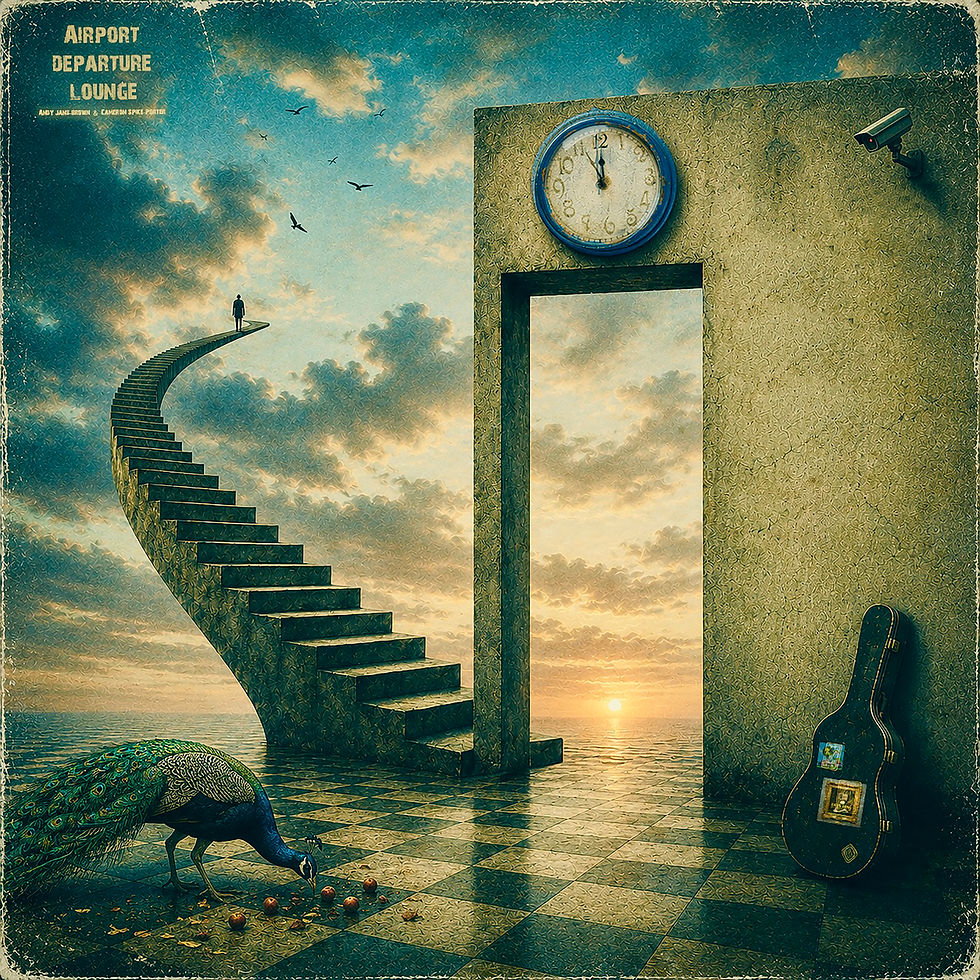
My recent album, Airport Departure Lounge, is all about a world on the brink. A place where the future arrives faster than we can process it. We need to start having some complex and nuanced discussions about our future, and this also means we must honestly face the injustices of our past. There’s no way around it. These are difficult and uncomfortable discussions. The moral and potentially legal consequences will change us forever. I believe we should all be adding our voices to the great choir of democracy and the discussion of where to from here?
Now obviously I’m suspicious of systems that allow power without accountability. Whether that's governments, multinational corporations, billionaires, political parties, AI companies, or, for that matter, AI itself... Who is accountable? Who answers to the people affected? Many people say they're afraid of AI. I’m not afraid of AI, I actually think AI will be great for live music and theatre and stand up comedy and sport etc, (anything where humans gather for a human experience) but I am afraid of the companies that control it. A hammer isn't frightening. Someone holding a hammer can be. AI amplifies intention. It can amplify generosity. It can amplify curiosity. It can amplify education. It can also amplify surveillance, manipulation, monopoly and inequality.
The technology itself doesn't settle those questions. Human institutions do. If machines produce most economic value...Who owns that productivity? Should society receive a dividend? What happens to meaning when work changes? How do artists participate in value created from culture? What obligations do companies have to the people whose work helped create these systems?
As mentioned, as we open up discussion about how to navigate the future, we will be faced with inevitable questions of the past. This may confront a lot of us as we face our privileges and even our moral hypocrisy. It's very easy to point outward, but much harder to point inward.
Every one of us, including those who argue most passionately for justice benefits from systems we inherited but didn't create. Our phones contain minerals mined under difficult conditions.
Our clothes may have been sewn by underpaid workers. Our food has environmental costs.
Our music streams through enormous data centres. And of course, the Military Industrial Complex. We're entangled all of us. I shall never forget when I was at university, and there was a sausage sizzle welcoming us all as new students. We all played pool and drank beer from the Uni Bar whilst the War in Iraq was streaming on all the tv sets above. It felt barbaric to know that humans were on the receiving end of those hypersonic missiles and that those explosions were the tremors of someone’s future PTSD, whilst we were laughing away, eating sausage and drinking beer. I remember filling my car up with petrol at the service station afterwards and weeping as I imagined the petrol itself was blood pouring into my tank.
Recognising our entanglement isn't an invitation to despair or self-flagellation.
It's an invitation to humility. It means none of us gets to stand completely outside history and pronounce judgment from a place of perfect innocence.
We're all implicated to some degree.
That doesn't mean we abandon the pursuit of justice; it means we pursue it without imagining ourselves morally pure.
Power has a way of making other human beings feel abstract. Love does the opposite. It makes people real and concrete again. I guess a decent society creates the conditions in which people have a genuine opportunity to stand on their own feet with dignity as they get to meaning make together.
It's a deep dive. I mean as we consider what may even lay ahead in terms of AI capability and what becomes of the human workforce, do we end up with some kind Universal Basic Income? How does that work? Are royalties shared with artists and thinkers who contributed to the models learning? There are so many factors all coming at once, a multifaceted conundrum racing at rocket speed with so many implications. No wonder people are grasping for certainty in the face of such uncertainty. All the gender stuff, the injustices against first nations people, immigration, injustices against the animal world. War Crimes! I mean wow! It's mind blowing to look at it honestly and fairly and try to even begin to have a conversation about our hopes and fears.
I guess all of this is feeding into my questions and thoughts and wanting to say something to articulate my inner abstract; and wanting to contribute in some small way to the great symphony of voices singing. I think the future can be an exciting place, but not without struggle. Not without accountability, responsibility and decency. There's a whole system that has hidden injustice in plain sight. 'Trump's swamp', I'd call it. And what of that? Where does that all go? I think we've only seen the tip of the Iceberg with the Epstein Files for example, that is surely a pandora's box of human horrors, but let's not dehumanise the perpetrators, like the Nazi's of World War II, these crimes are committed by humans. We did those terrible things to one another. It was us all along. Some people like to burn witches, have scapegoats to create a comfortable distance from their dark and cold shadows, but we must remember that we are a part of the animal kingdom, we are not above it. One of the strengths of liberalism, has been this acknowledgement. Certain religious or political ideologies have some finished perfect state in mind; The Rapture, or when we Make America Great Again, or when we exterminate the vermin, burn the witches, whatever evil it is we wish to commit in the name of purity, it's still a madness, some kind of fever dream, the kind of mob rule that liberalism has very effectively tried to counter, through the self correction of our democracy, our legal system and our governance. This is another reason why I hold democracy in such high regard, but more of that soon also. Anyway, the whole thing, everything we are living though is Shakespearean or biblical! Which makes me think of Matthew 19:24: "Again I tell you, it is easier for a camel to go through the eye of a needle than for someone who is rich to enter the kingdom of God."
Now I don’t quote this because I think wealth is bad, not at all, I believe in personal freedom, and in striving for a better way of life absolutely! I believe in encouraging someone's strengths, and allowing their successes to inspire us all, but because comfort can afford us distance from the known or knowable consequences of our inheritance, this is why I quote Matthew. Now, I'm not a practicing christian as such, and the bible is just a book to me, full of great wisdom, up there with Oscar Wilde and William Blake, but and to clarify, for me it's a parable, a great symbol and metaphor, an analogy of how best to live a moral life, I don't think of it as the word of the one and only god. But anyway let me continue, comfort can become insulation. Insulation can become blindness and blindness can become indifference. Indifference to the suffering of others. It's all worth a mention as I try to walk you through the nuance of my thinking.
Ok, so here we go…….
We are living through one of the largest psychological manipulation experiments in human history, the scientists who begun conducting it, may themselves have even been replaced by bots and larger AI models, and I feel it’s my duty and responsibility to at least attempt to break some of this spell, or at the very least, name it; futile as you may think this is.
When I say ‘psychological manipulation’, I don’t mean ‘mind control’ in any Hollywood Movie sense; no microchips, no sci-fi hypnosis ray guns.
No not quite The Manchurian Candidate, with shadowy villains played by tall dark and handsomes, or blinking screens and stand-in puppet politicians.
No, the real history of psychological influence is far more ordinary, but arguably far more dangerous. For that which we take for granted makes us blind and moving forward we’re gunna need some sharp eyes open.
Now all this begins long before the digital age.
In the early 20th century, Edward Bernays, who was the nephew of Freud, called propaganda “the engineering of consent.” Once we learned how to sell cigarettes and wars with psychology, the question was never whether we’d use these tools in politics. It was only: How far would we go?
By the 1960s, psychologists were already mapping out the frightening vulnerabilities of the human mind: Milgram showed that ordinary people would administer shocks that they believed were lethal if instructed by an authority figure dressed in a white lab coat. Then Asch showed that people would deny the evidence of their own eyes just to conform and fit in with the group. And finally, Zimbardo showed that by simply playing the roles of a guard or a prisoner could twist behaviour within days.
Meanwhile, governments went darker MK-Ultra (1953–1973) experimented with LSD, sensory deprivation, hypnosis, and electroshocks on unwitting subjects in a misguided attempt to control minds. Brutal, unethical, shocking yet real.
By the late 20th century, we’d moved from coercion to saturation; with bombarding 24-hour news cycles of continuous streams of programmed narrative, talkback radio and TV heads setting limits of argument, framing what was acceptable debate, PR spin, more and more manipulative ads, wedge politics and of course cults refining techniques of isolation, love-bombing, us vs them thinking and total information control.
Then came the internet.
And with it, personalised reality.
The old model was one message broadcast to millions.The new model is millions of messages, each tailored precisely to any one person’s fears, biases and cravings to slowly shift their prejudice one way or another.
Eli Pariser’s “filter bubble” idea (2011) warned that algorithms would surround each of us with information we agree with, hide uncomfortable truths, and fragment public discourse.
This is where Cambridge Analytica enters the story.
Christopher Wylie is the whistle-blower who revealed how Cambridge Analytica took techniques developed for psychological operations in conflict zones and aimed them at voters. They built pyschological profiles from the Facebook data of tens of millions; remember all of those silly questionnaires? What famous celebrity are you most like? Etc etc ad infinitum. They farmed our likes and our browsing habits; how long we paused on each post before moving on, what we moved on to. The whole shebang. (Big Five personality traits: openness, conscientiousness, extraversion, agreeableness, neuroticism) they then identified small segments that were more prone to fear, anger, or “dark triad” traits (narcissism, Machiavellianism, psychopathy).
Wylie describes this as taking techniques designed to break down psychological resilience factors.
They found that these narcissistic and neurotic types of people would do the on-line work for them by being loud and aggressive and bullying others, and helping to control the narrative.
They also micro-targeted people with tailored messages on Facebook and other platforms, designed not just to persuade but to inflame, divide, and demoralise; often different messages to different groups (suppression, anger-stoking, etc )
Even if “percepticide” is not yet a mainstream term, the concept is spot on:
By placing people in echo chambers (closed groups, tailored feeds, conspiracy forums), and feeding them only content that confirms their biases, you gradually; kill their capacity to perceive alternative realities, make them distrust all other sources, and build loyalty around shared “nonsense,” as one of the thinkers Wylie quotes puts it.
Steve Bannon was heavily involved in Cambridge Analytica, there was also involvement with Russian Fossil Fuel Oligarchs.Many of Trumps catch phrases such as ‘Drain the swamp’ came from Cambridge Analytica focus groups.
They were major players in getting Trump elected in his first term.
This was not “believe our message.”It was: “Sow seeds of doubt, Trust nothing. Cling to us. We are the new familiarity, the new certainty”
A personalised propaganda loop, digital percepticide, and the killing of perception.Not breaking the mind, as MK-Ultra attempted, but fracturing shared reality itself, often by stripping individuals of their resilience factors, leaving them vulnerable where facts were buried in a huge pile of propaganda and outright bullshit till everything seemed doubtful, except for the algorithm itself. In that we trusted.
That which is obvious is blinding.
Or as I first came across that idea, whilst wandering the streets of Paris aimlessly and found it as a piece of graffiti on a wall, “L'évidence crève les yeux.”, which is perhaps more poetic and certainly more visceral. It translates to “the obvious ‘bursts’ or ‘punctures’ the eyes.”
Oh yes, my time in Paris made me a flâneur .The flâneur isn't simply a tourist. Nor is he merely idle. He is someone who strolls through the city reading it as though it were a book. Every shop window, every gallery, every conversation overheard, every bridge, every smell, every puddle, every cobble stone, every park, every water fountain and every pigeon becomes part of a text.
But I digress, I’m lost for a moment in memories and reveries. Where was I? Where am I?
Oh, yes, so no, this isn’t some kind of conspiracy theory. It's the documented history of modern manipulation available in plain sight.
And movements like MAGA, One Nation and Reclaim Australia have ridden this wave brilliantly; turning grievance into identity, fear into belonging, doubt into dogma and turning healthy scepticism into a weapon against truth itself. Any movement that benefits from playing us against one another, or scapegoating easy targets should instantly set off warning signs. I recall years ago seeing a wonderful exhibition on the history of propaganda, and one of the things I noticed was that they all dehumanised their enemies. This is a very quick way of assessing if something is propaganda. Sorry to refer again to Trump, but his share of the image of the Obamas as monkeys for example falls directly into this category. There are clear warning signs is all I'm trying to say and whilst we are being micro-targeted through psychometrics and drip fed dopamine as reward, enticed into rage by click bait and played against one another, and all the while Billionaires are becoming Trillionaires........um.......
That’s why I’m writing this.Because I believe that democracy is a truly wonderful human achievement and worth fighting for and cannot survive if its citizens are turned into targets rather than participants; and let’s be frank, at this late hour in our species’ story, anything that deliberately sets us against one another is not just another opinion, it’s a threat to our survival and a hurdle we must get over.
If there’s a single thread running through the whole human journey, it is this; We survived because we cooperated.
Harari, in Sapiens, describes our unique ability to work together in large, flexible groups built on shared stories; myths, nations, laws, human rights and money.
We didn’t outrun predators. We didn’t out-muscle them. We out-cooperated them. It was never about the survival of the fittest; and always about the survival of the most adaptive.
Every major leap, whether agriculture, medicine, science or democracy, has been built on our capacity to join our strengths and imagine futures together.
This matters now because the stakes have never been higher. We're on the brink. The immense power of AI, if centralised into the hands of those who's comfort has made them blind and indifferent to the sufferings of others; then we are heading for the type of dystopian dictatorship that not even Orwell could conceive. The rule of law, our engagement, involvement and authorship in the writing of the laws couldn't be more important. The very fabric of democracy and the institutions that uphold it couldn't be more important.
Ok, so let me now address some of the elephants in the room.
Firstly, the pandemic.
This was a time of complete chaos. People were dying on mass and Governments and the World Health Organization were racing to find any kind of fix at all. I don’t believe it were a planned thing, a ‘Plandemic’ as I heard it said. Although our greatest triumphs as a species have come about through cooperation. It’s way easier said than done. I just don’t believe our governments are that united or competent. Let alone our international relationships. Governments are made up of people and people are flawed; therefore, governments are flawed too.
Try to get five people together in a band to a rehearsal at the same time, or even an eight year old out the door to get to school on time. Organize a wedding and who will sit next to whom? Try passing a good idea through Parliament or the Senate, and you’ll soon see just how complex these things are. I’m always sceptical of conspiracy theories that can somehow tie together otherwise unrelated events with convenient and pointed simplicity. Nothing in life is ever that simple. Sometimes, I wish it were.
In saying that though, I do believe in the market forces of disaster capitalism, which if you’re seeking a clear understanding of the workings of how big business takes advantage of crisis, you must read Naomi Klein’s exceptionally well researched and documented book, ‘The Shock Doctrine’.
There was a push to find a vaccine.A number of big pharma companies, many of them with shady histories, raced to fill the void.Corners were cut. It wasn’t ideal. It was most certainly on the nose. There was big money to be made.Governments made vaccines mandatory which made many people even more sceptical, and also frightened.There was a new type of vaccine put forward, MRNA, this also scared people. The fear made them more susceptible to conspiracy theories.
Those with a vested interest in fostering doubt in institutions seized their moment as too did the disaster capitalists.
I’m not here to shame anyone for being hesitant or afraid of getting a vaccine. I personally was terrified. Terrified of dying from the vaccine, terrified of dying from covid. Just Terrified and completely overwhelmed. To keep my job, remember all of my music gigs were gone in a day, I had to take on work as a funeral director to feed my family, and to keep my job I had to get the jab.I actually think it was fair to be questioning of the legitimacy of these vaccines. An idea such as, “My body – My choice” is to me a fairly reasonable argument.
When the vaccines arrived, I felt two things at once; relief or hope that science had delivered something that might help us return to some kind of normalcy.And sadness, because the moment that should have united us all tore us further apart.
I myself made peace within myself regarding getting it, by thinking that a vaccine is a social contract in biological form.
It’s the idea that my body is connected to yours, that my health affects your health, and that none of us exist in isolation, but that was my logic, and I didn’t hold it against others that still weren’t compelled by such an idea, and certainly didn't shame them, good people with pure hearts took a stand on this against Government over-reach and corporate greed and corruption, many lost their jobs - it really was such an awful and divisive time, and let’s face it, it didn’t prevent you from getting COVID or spreading it, like other successful vaccines. Heartbreaking! All of this, the whole god damned mess of it all diminished trust in our institutions which is unfortunate, because it most certainly divided us further.
I saw friends and families ripped apart over the issue. Funerals where you could only have 10 unvaccinated people by law or no limit if everyone was vaccinated. I saw fights between grieving family members, with fingers pointed, “So you’d rather Dad have 100 acquaintances at his funeral, than have his own son because I won’t get your Government approved vaccine?”It was brutal!
Reptilian brains with ferocious teeth biting at one another. Each scared into a state of fight or flight. I personally shrank a lot during these years and struggled to find my voice. I struggled to speak. I struggled to write songs. I only managed to put out one song through that whole era, ‘To be loved’ a ballad, reflecting on missing the unconditional love of my mother. I don’t deal with conflict well. I freeze. I didn’t like the way friends and families fought over this issue. I wanted to find a song in my soul that we could all relate to. “To be loved’ was my most heartfelt and honest attempt.Although I got the vaccine, I held no grudge against those who chose not to. I understood and respected their choice. I certainly did not wear Pfizer laurels around my profile picture on Facebook. No, I was raised on the outsider comedy of Bill Hicks. I don’t wish to be anyone’s poster boy, and especially when they’re not even paying me for it, and when they’re company has a very questionable past.
But I’m not passing judgement here, on anyone’s position. I’m just daring, after many years of silence on the matter, to speak my shy truth. Fear is human.Misinformation preys on fear.And for years we’d already been primed by social media echo chambers, by distrust in institutions, by a culture that tells us every expert is suspect.
But here is the truth I came to sit with; the rollout was far from perfect and Governments made lots of mistakes in all the chaos.Pharmaceutical companies made record profits and the messaging was terrible, clumsy and confusing. The rich got richer and the poor were the hardest hit.
But the underlying principle was still solid for me; we are responsible for each other.
And what moved me most during that time were not the debates,but the quiet acts of care, such as; nurses working impossible hours, people delivering food to isolated neighbours and strangers checking in on one another.
But I was also moved by the people putting themselves at risk and taking to the streets in peaceful protest, even though I didn’t agree with them, I certainly supported their right to do so and felt inspired by their political activism.
And I was utterly shocked and appalled by the Police response of rubber bullets in Melbourne and other such overreaches not just of the Andrew’s Government in Victoria, but other Governments who also saw the moment as an opportunity to seize greater power.
To my mind that just drove good people into the waiting hands of those who would harvest this growing distrust in institutions and feed it straight into the mouth of strong-arm authoritarianism.
I’m not a scientist, and although I think we should all hold our governments to account and be free to question authority at every step, still I do sense some mutual benefit in the idea of a vaccine. For what is it if not an acknowledgement that your breath matters to me?That your safety is bound to mine?That my body participates in your wellbeing?
It is, in a way, a biological poem about interdependence.
And yes, in some ways, anger during COVID was misdirected, but it had to go somewhere. Fear left in isolation is also a form of torture, and none suffered more than my dear friends and family from my birthplace of Melbourne.People were furious at masks, at lockdowns, at vaccines, at nurses, at scientists.But the real enemy was the virus, poverty, inequality, and 40 years of political neglect that left our systems fragile.
I’m glad my dear and beautiful Nan, had only passed away at the ripe old age of 99 only a few years earlier. She had spent the last 3 years of her life in a nursing home and had lived for her visits from her Great- great grandchildren. If she had been alive during COVID, I’m sure she would have said, “if I can’t see me my family, give me COVID. I’d rather die.”Isolation is one of the biggest killers in our society. We need each other.
But when I look back on that time, what strikes me most is this; the panic was real.
Normally rational people hoarded toilet paper. Need we say anything more?And fear makes the reptilian brain roar while the prefrontal cortex goes quiet.
In that void, conspiracy thrives.Authoritarians thrive.Movements like MAGA thrive.
But hey, even if you believe it was a lab made virus, leaked to wreak havoc on the world and control the masses, and then somehow the virus shifted from COVID to WOKE, and to then jump onto Trumps gold plated merch selling train of blatant contempt for the rule of law and the agency of female reproductive rights; and his blatant deliberate misleading lie telling, disregarding all facts as though he decides reality, his constant undermining and threats to the free press, the destruction of US Aid, education, health care, immigrants and the less fortunate, all whilst he’s helping himself through crypto corruption, selling pardons and privileges to the highest bidder. So, if that’s where you ended up, if your fear and rage was so easily shifted from mandatory masks and vaccines to trans people wanting to play sport, kids demanding kitty litter in their class rooms and other minority rights misrepresentation, like fabricated tall stories of immigrants eating cats and dogs etc, and you didn’t pause to consider your scepticism at that point, then you are not a true sceptic, but more on that in a moment. By placing all of this within the framework of Cambridge Analytica's psychological manipulation, we can better understand each other. If you haven't already, you really should read Christopher Wylie's whistle blower account.
I think also to Erich Fromm's ideas in his wonderful book, The Fear Of Freedom, where he studies the rise of fascism in Nazi Germany, and comes to the conclusion, that people crave certainty and dread freedom. That as they gain independence from traditional communal structures, such as the church, they can feel isolated, uncertain and anxious, like a sheep that has left it's flock. To fill that void they often run into the arms of the strongman, the authoritarian figure who with emotionally potent over-simplifications can provide a sense of certainty. People will give up the difficult and complex work of being free for the ease of conformity, belonging and feeling safely aligned to the strong arm of the bully.
Fear narrows the field of vision. Things appear more certain when not informed by the contrary and more nuanced information that exists in the periphery. The more we focus intensely on something, and reinforce those neural pathways, the more sure we become that what we are seeing or thinking is true. As I said at the start, I'm suspicious of certainty and prefer instead curiosity. The more open we remain to seeing multiple perspectives and angles, the closer we might be able to get to traversing the current tight rope hung between extremities.
Milan Kundera once wrote.
"The struggle of man against power is the struggle of memory against forgetting."
The rise of fascism, with its jingoistic nationalism and the terrors that it inflicted are less than a century old. How quickly we forget.
But I also think there's a few other struggles running alongside that.
One is, the struggle of nuance against over-simplification.
Fear simplifies, but love complicates.
Propaganda simplifies, whereas art complicates.
Algorithms certainly simplify, but poetry, complicates.
That's why I think artists so often feel out of step with the contemporary world and the internet in general. The internet rewards the sentence that closes the conversation, whereas art rewards the sentence that opens it.
Now remember earlier. I mentioned that I had been editing this piece, and that there were 3 events thaat were going through my mind today, Glen Hansard's passing being the first, well the second is the Congressional hearing of Dr Fauci. I thought it would be worth mentioning here as it relates to what I've written above. I see on my social media feeds, that if you're pro Trump you are sharing the moment he pleads the fifth as though it qualifies that he is some kind of villain , personally responsible for all the hardships of the COVID pandemic, but if you're left leaning, you'll be pointing out that the release of his diaries points to the incompetence of Trump. There is no where to go with any of this. It just seems like political nonsense. A need for a scapegoat. A witch to burn because we fear the things we can't understand.
How do we respond to complexity without collapsing into certainty?
Modern politics has become strangely theatrical.
Whether it's Fauci, Trump, Biden, Johnson, Hanson, Albanese, whoever...
they become characters in morality plays.
The audience has already decided whether they're watching a hero or a villain before the curtain even rises.
The facts almost become secondary. The media becomes like the work of a hypnotist.
A hypnotist doesn't necessarily persuade someone by inventing a lie.
They narrow attention.
Politics often does the same. "Look only here." "Look into my eyes". "Ignore everything else."
The danger isn't merely misinformation.
It's selective information.
Humans seem almost neurologically wired to prefer stories with a hero, a villain, and a satisfying ending.
Reality stubbornly refuses to cooperate.
COVID, in particular, was almost certainly too large and too chaotic to fit comfortably into a single narrative of heroes and villains. Governments made some decisions that likely saved lives; they also made mistakes, sometimes serious ones. Scientific understanding evolved rapidly under immense uncertainty. That combination makes the period very difficult to reduce to a simple verdict, even though public debate often tries to do exactly that. The evidence just isn't there to support it. The third event that has been swimming in my mind today is the mass migration from Morocco into Spain. Now, it's obviously a massive crisis. It's absolutely shocking, almost unbelievable to conceive. The two countries obviously share a very complex history and the situation there is very unique because of that. I don't really fully understand it yet, of course I'll remain open and curious. Morocco have mass unemployment problems, poorly managed and corrupt governance and people are looking for opportunities to start a new life in Europe. This will no doubt be shared by the right as a clear indicator that we need to be hard on immigration, and let's face it, such numbers are completely unmanageable, but for me it's of course always way more complex than such emotionally-potent oversimplifications. Again I think of responsibility vs blame. In what ways does our way of life lead to the sufferings of others? We are all so connected. Some countries more so than others. Our actions have consequences. If we exploit poorer countries, steal their resources, bomb them to pieces, shouldn't we have to deal with some of those consequences? I think as the effects of climate change, war, and even perhaps as AI replaces certain jobs over the next 20 or so years, we might see more and more immigrants looking for a better life. Can you blame them?
Can you blame someone for wanting a safer future for their children?
Usually not.
Can receiving countries simply absorb unlimited migration?
Also no.
Those two truths can coexist. That's where nuance lives.
A nation has legitimate interests in maintaining social cohesion, infrastructure, and a functioning immigration system.
A migrant has legitimate hopes for safety, dignity, and opportunity.
Those aren't automatically incompatible.
The challenge is that politics often frames them as though one side's humanity requires denying the other's.
History certainly shows that powerful nations have often benefited from unequal relationships, colonialism, resource extraction, proxy conflicts, and interventions. Those histories have shaped present-day inequalities in many parts of the world.
At the same time, migration patterns are influenced by many factors beyond the actions of wealthy countries: domestic governance, corruption, demographic trends, education, regional conflicts, environmental pressures, and economic policy all play important roles. So while historical responsibility is part of the picture, it's rarely the whole picture.
Again... complexity. There is great video by the blogger and ex Australian Federal Policeman Carrick Ryan, where he breaks down the complexity of the whole immigration narrative. I highly recommend you check it out on YouTube.
Remember the idea that propaganda begins when we dehumanise others; immigration is most certainly victim to propaganda in these terms.
You can believe immigration needs stronger management, while recognising the humanity of migrants. Look, Governments are obviously flawed, and easily corrupted by Corporate money, but this isn't the end of democracy, it's simply the calling. We need more involvement of community minded folk such as you and me. But even then, the age old problem of "absolute power corrupts absolutely", or as my Grandfather said, "you inherit the corruption of your position", so the struggles are real. Prudence and honesty become the best forward. A careful self watch. It's so easy to point the finger at those covered in mud, whilst you're standing outside the ring, betting and cheering on the result of the wrestle. We are not morally superior, fortunately in a liberal democracy we have processes in place for self correction, but it requires participation.
You can criticise pandemic decisions, without turning individuals into monsters.
You can oppose particular wars, without imagining everyone on one side is evil.
That seems healthier than assuming every disagreement is evidence of moral failure.
One of the oldest mechanisms in politics and war is propaganda.
Dehumanisation is almost always the first casualty before the second casualty.
Before people can be harmed on a large scale, they usually have to become something else in the public imagination.
Not neighbours. Not fathers. Not daughters. Not musicians. Not children.
They become: Vermin, Parasites, Cockroaches, Invaders, Infidels, Fascists, Communists, Elites, Terrorists and Sheep.
Sometimes those labels describe real ideologies or genuine threats. But the danger begins when the label consumes the person. Once someone is no longer perceived as fully human, empathy becomes much easier to suspend.
The History of Propaganda exhibition that I saw in Melbourne all those years ago was revealing something almost universal about propaganda. Different countries. Different centuries. Different political systems.
Same technique.
Shrink the complexity of a human being until only a symbol remains.
Again I sing the song of embracing curiosity and complexity, and holding two opposing views at once. Truth is tone.
Music and all great art performs a tiny act of re-humanisation.
Perhaps that's why authoritarian movements throughout history have often been suspicious of artists, poets, comedians, novelists and musicians. These people complicate neat narratives. They encourage identification across boundaries. They remind us that the "other" has an interior life.
Now to the other elephant.
Whether you believe climate change is; human-driven, natural cycles, or something still uncertain, one simple truth remains; the climate itself is changing.
Here in Lismore, we have lived through two “once in a century” floods in eight years. Insurance companies adjust premiums because they see the risk.Councils adjust zoning because they see the seas rising. Farmers adjust planting seasons.Our bodies feel the change in the heat.
You don’t need a PhD to know something is shifting.
Now you might be sceptical? And that’s fair enough.But then be sceptical all the way around; sceptical of fossil fuel PR campaigns, sceptical of media outrage machines, sceptical of billionaires funding denial, sceptical of political movements profiting from division, sceptical of conspiracy entertainers on YouTube, sceptical of your own bias and sure, sceptical of mine too.
Scepticism that travels only in one direction is not scepticism. It's ideology wearing a mask.
And ideology has never once saved a species. Cooperation has.
We have never needed each other more.
Scepticism is a virtue, but selective scepticism is a vice.
Real scepticism asks questions, listens, stays humble, withholds belief until evidence is strong and remains open to correction.
It says, “I don’t know yet, explain your theory to me and help me understand.”
But when scepticism becomes a habit, or a shield, an identity, or a weapon, then it’s no longer scepticism. It’s simply prejudice wearing the clothes of doubt.
Pseudo-scepticism accepts evidence only when it fits your worldview, rejects all expertise that contradicts it, starts with the conclusion and works backwards, demands impossible proof (“100% certainty or nothing”) and is never resolved by new facts
It feels like thinking, but it is actually just fear.
And fear is the oldest manipulator of all.
To be truly sceptical is to doubt with integrity and to apply the same standard of scrutiny to your tribe as you do to the other.
This is democracy’s immune system.And when it breaks down, democracy becomes terminally ill.
Before I encountered Rousseau and The Social Contract, I thought freedom meant “no fences”,like the old cowboy fantasy, “Oh give me land lots of land under stary skies above, don’t fence me in.”
But Rousseau offered me something deeper.
When we enter the body politic, when we become citizens, we don’t lose our freedom.We transform it.
We trade impulse for intention, isolation for belonging, raw autonomy for shared self-governance and chaos for a law we co-create. it's responsibility vs blame. If you think our laws are wrong or that we need greater protections, guess what? In our liberal democracy there is a process by which you can get involved in the very authorship of those new laws. Democracy requires us all to participate.
To be a citizen is to place trust in strangers; surgeons, teachers, engineers, firefighters, judges and people you will never meet but whose work literally holds your life.
It’s also to be the beneficiary of bureaucracy. Now, as Yuval Noah Harari puts it in his book Nexus when he makes the somewhat counterintuitive point that bureaucracy, while often frustrating, is one of the technologies that allows large societies to function at all.
I mean, who is gunna deal with the sewerage? Who is gunna collect the garbage? Or in Harari’s words, “How else to manage big networks? Holistic approaches don’t make a hospital function, or the sewage system work.”
The broader argument Harari makes is that we tend to only notice bureaucracy only when it fails; when we're waiting in a queue or filling out forms. But the invisible successes are everywhere: clean drinking water, sewerage, rubbish collection, hospitals, vaccination programmes, transport systems, tax collection, and the countless administrative processes that allow millions of strangers to cooperate every day. Bureaucracy imposes order, that is what it does, and sure not everything fits into categories and boxes, I’m 100% in support of that, but while that order can become too rigid and detached from reality, without it, modern civilisation simply couldn't operate.
We celebrate our sporting heroes and our movie stars, but civilisation is just as dependent on the anonymous people who ensure that, each morning, the water flows, the bins disappear, and the lights come on.
Now let’s also talk about your passport.
Your passport is not just a convenience. It is the promise of protection and the weight of a whole country in your pocket.
Yes, we obey laws, we curb our anti-social and animalistic instincts.But only legitimate ones, laws that align with the freedom we collectively author.
Let me just say one other thing quickly about freedom and what I learned from J.S Mill’s book, On Liberty. Freedom is defined by two categories; Negative Liberty, or Freedom from oppression and threat, and Positive Liberty Freedom to express yourself as you see fit. Now obviously Negative Liberty is what we hope for everyone, Positive Liberty must have the constraints that your positive freedom can not take away or impose upon someone’s negative liberty. It’s a no-brainer. We have laws to prevent harm and protect basic human rights. We curb our positive liberty for social cohesion. This is what binds us in the social contract.
This is why January 6th broke something in me.
It wasn’t just an attack on a building. It was the anti–social contract in action. It was a crowd declaring: “We will only accept the law when it favours us.” That shreds the invisible covenant that holds a republic together.
Democracy is not simply voting, it is the agreement to lose and to try again. To trust that the system belongs to all of us, not just our side.
When that trust is gone, the body politic becomes diseased.
Yet even there, Rousseau reminds us that the General Will; the desire for the common good still flickers in small acts of decency, such as a neighbour helping, a stranger showing kindness, a citizen standing up for someone they did not have to stand up for.
That’s what led me to coin a word for this commitment; ‘Aureuson’ (n.) the golden burden of citizenship; the shared weight we lift together, precious because it costs us something,binding us not by force but by choice.
Citizenship is an Aureuson; a gift because it asks something of us; and a burden because it grants us something priceless. It’s a responsibility. And one thing I’ve learned in life is that though responsibility may seem at first like a weight to bear, like water, the sunlight and fertile soil, it’s the very stuff that makes us grow.
For every burden is a gift and every gift a burden. This is a very nuanced paradox that has taken me half a century to comprehend.
Fear collapses nuance and narrows the field of vision. It pushes the brain into survival mode.
Algorithms do the same; but deliberately.
The platforms that shape public conversation are built to reward outrage, simplicity, tribalism and emotional intensity. They are also set up to punish nuance, patience, humility, complexity and kindness.
Fear activates our reptilian brain. Algorithms amplify it.
Together they create a world wide web amygdala hijack.
In that state, we are incapable of asking, “Is this true?”
Instead, we ask, “Am I safe? What do my friends think? Does this fit with my tribe?”
Truth becomes optional and facts become negotiable.Reality fragments into curated feeds.
So how does truth survive?
Not as slogans.Not as ideology.Not as perfect arguments.
Truth survives as tone.
As the tremor in a voice.The break in a sentence.The honesty in a musician bending a note because the heart demanded it.
Tolstoy called music “the shorthand of emotion.”Kerouac insisted “the only truth is music.”
Nietzsche said, “Without music, life would be a mistake.”Cohen taught us that “there is a crack in everything and that’s how the light gets in.”
Art, music and philosophy are the nervous system’s regulators.They widen the narrow corridor fear creates and they restore nuance.They reopen empathy and they let truth resonate again.
Truth is not a possession. It is not a doctrine. It is not a conclusion.
Truth is fluid, it’s ever evolving.
Truth is a tone.
Sing your hearts out!
And when spoken honestly, vulnerably, and courageously; it cannot be mistaken.
After everything; the manipulation, the fear, the lies, the division, the algorithmic chaos and the erosion of trust, it would be easy to give in to despair.
Don’t!
Because beneath the noise, beneath the outrage, beneath the trembling of democracy, there is still a deeper current; the perennial, stubborn human desire for meaning, kindness, truth, and belonging.
We see it every day in a million different ways, from a neighbour helping in a flood, a teacher believing in a child, a nurse holding a stranger’s hand, a citizen protesting or voting with a full heart, and when a musician is playing or singing a note that makes the room go silent.
This is democracy’s real foundation.Not parties and not politicians, but people; you and me.
And yes, the forces tearing us apart are powerful; awful! And yes, authoritarianism is rising, and yes, propaganda is becoming more sophisticated, and yes, the algorithm is an insatiable hungry god that can’t get enough of our attention.
But they have not won. We still have each other.
Citizenship is not just paperwork. It is a promise.
A promise that your fate matters to me, and mine to you, even if we don’t know each other.
A promise that the Aureuson; the golden burden, is one we choose to lift together.
A promise that “love thy neighbour” is not naïve, but revolutionary.
Democracy may be trembling, but it is not dead.Truth may be squeezed, but it is not silent.Hope may be fragile, but it is still here; stubborn as dawn.
So, stand tall together, dance and sing along.We’ve more in common than we realise. Take care and ownership of your nervous systems. Stay curious and open to the truth in your hearts.
The better story is still ours to write. May we remain curious and tender and open to the possibility that people who disagree can still recognise each other's humanity, value and defend each other’s freedom of speech. Remember not even identical twins share the same fingerprint. On a cellular level there is difference. Life itself celebrates difference. So, is it really a surprise that if our brains are a cluster of cells, and that each of us has unique cells, that we would disagree about the fundamental meaning of existence? Or is it more surprising that we can agree at all? Which brings me back to an that earlier idea; that our success as a species is defined more by our cooperation than by any wars we have fought and won, but by our astonishing capacity to cooperate. Civilisation is not the story of one tribe defeating another. It is the story of strangers finding ways to build something together. Our greatest victory is measured by this. So what are we working together for?
Not merely greater GDP. Not merely greater technological capability.
But perhaps toward becoming a little more worthy of the intelligence we're creating.
AI may well become astonishingly capable. The more difficult question is whether we become more wise? And if we can somehow develop for ourselves a greater capacity for wisdom? Technology can increase our power almost without limit. It doesn't automatically increase our capacity for compassion, restraint or moral imagination.
Those qualities still have to be cultivated, person by person, conversation by conversation, and heartbreak by heartbreak. And remember, the difference between fear and openness or curiosity, is not so much about where you are standing, but rather where you are looking, or what you are giving your attention to. With heart,
Andy


Comments